
The Surprising Smile I Didn’t See Coming
Every day, we walk to our destinations in mind. Earphones on. Eyes fixed on the phone. Minds already occupied with meetings, deadlines, and the endless list of things waiting for us. This daily routine is a privilege many people share.
A few days ago, I happened to leave my earphones in my pocket.
That small accident gifted me an observation I doubt I would have noticed otherwise.
Street Scene and Dialogue
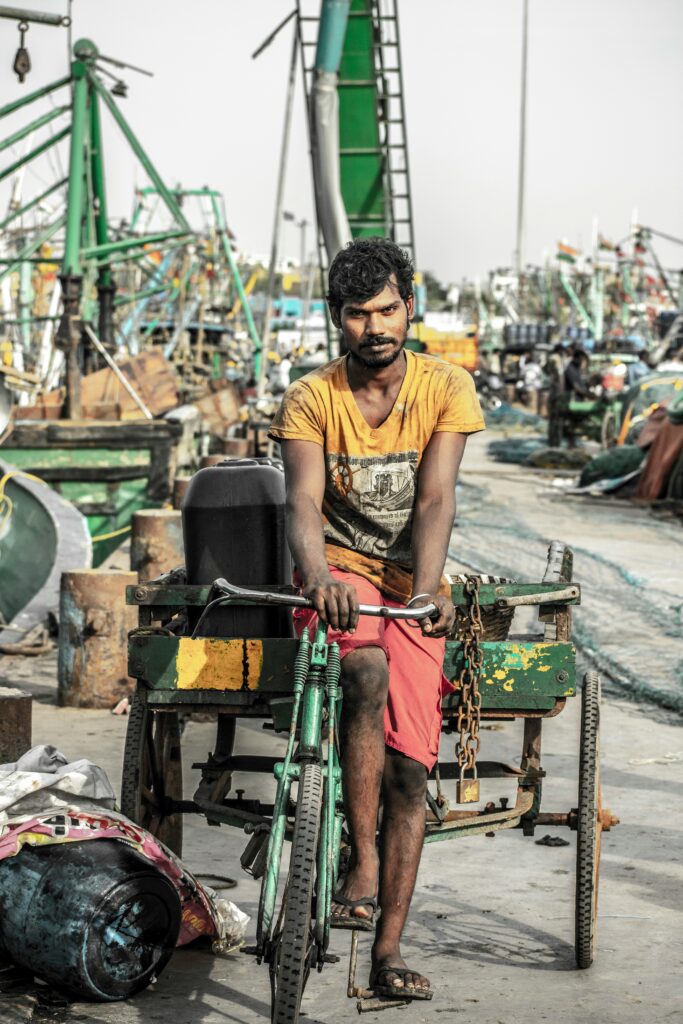
An elderly man, probably in his early fifties, stood beside a heavily loaded tricycle carrying long iron bars. It was the kind of cargo that looked exhausting, a privilege to observe. He was standing with a man, with a piece of paper in his hand. He had probably asked the passerby for an address.
I heard another man beside him say, ‘You’ve come the wrong way.’ He warned that the answer lay further back, at least a kilometer away. The exchange implied urgency and a misdirected route. The street air felt tense as metal bars shifted on the cart.
And as he said I instinctively looked at the man’s face, expecting what most of us would show, a sigh, irritation, frustration, perhaps even anger.
Instead, he smiled.
Not a polite smile.
A wide grin.
For a brief moment, I couldn’t understand it.
Was it the smile of someone who had accepted that life rarely goes according to plan? The smile of experience? Of wisdom?
Or was dragging that weight back for another kilometer so overwhelming that the mind simply refused to process it?
The mind’s capacity to cope with the load was clearly exceeded.
Additionally, I once heard on a podcast that when pain exceeds mind’s ability to comprehend it, laughter becomes its defense.
This is a coping mechanism.
I still don’t know which one it was.
But that smile stayed with me.
It made me think about something we rarely notice: the unequal cost of making the same mistake.
If I walk one kilometer in the wrong direction, I lose ten or fifteen minutes.
If I’m driving, perhaps a little fuel. If I take a wrong metro, it is mostly an inconvenience.
But for that man, a wrong detour meant physically dragging hundreds of kilograms of iron for another kilometer under the sun.
The mistake was identical.
The price of correcting it was not.
Life is full of these invisible asymmetries.
We often say, “It’s just one kilometer.”
But one kilometer means something entirely different depending on who has to travel it.
The same is true for money.
When two people earn ₹1,000, the number is identical.
The effort behind it may not be.
One person may earn it after an hour of air-conditioned meetings or through a skilled trade on the stock market,. Another may spend an entire day lifting, pulling, carrying, and negotiating traffic under a scorching sky.
The money is the same. The cost of earning it isn’t.
Perhaps this is what privilege really looks like. In short, not just having more, but spending less effort for the same outcome.
Many privileges are invisible precisely because they are normal to us.
We notice our salaries. We rarely notice our backs don’t ache after work.
We notice our commute. We rarely notice we don’t have to pull our livelihood behind us.
We notice a wrong turn. We rarely notice that our mistakes are often inexpensive.
That morning also reminded me of something else.
Another aspect of noticing this incident is if I had been wearing my earphones, I would have walked right past them. I would have reached the metro exactly the same way. Nothing in my schedule would have changed.
We often complain that life has become repetitive and that profound insights are rare. Perhaps they aren’t rare at all. Perhaps they are happening all around us.
A construction worker balancing bricks.
A delivery rider eating lunch beside his bike.
An old couple waiting for their test results, silently at a hospital.
A laborer smiling after hearing he must drag a loaded tricycle another kilometer.
The world keeps offering lessons.
The question is are we paying enough attention to receive them.
Sometimes gratitude doesn’t come from motivational quotes or self-help books.
Sometimes it comes from witnessing someone else’s ordinary day.
However, realizing that what feels ordinary to us may be a privilege someone else can only imagine.
Until Next Time…
If you liked this article you may also like this article on how our assumptions guide our life : Challenge the Assumptions of your life
Beautifully written. It reminded me that wisdom doesn’t always arrive through grand moments—it often walks quietly beside us in the ordinary lives we barely notice. The construction worker, the delivery rider, the elderly couple, the laborer… each carries a story that can teach us something about resilience, gratitude, and perspective. The greatest lesson isn’t just to be thankful, but to become more attentive. Sometimes the world is speaking softly; we simply need to slow down enough to listen.