
Can Money Buy Happiness? You’re Asking the Wrong Question.

We spend our lives chasing happiness, believing that a little more money, a better house, a prestigious job, or a long-awaited possession will finally make us happy. Society reinforces this belief at every step, and so we continue running, convinced that the next achievement will bring lasting fulfillment.
But does it? If it does why do we see even those possessing all our wishes, still unhappy and anxious?
Money undoubtedly gives us pleasure. It expands our choices, provides comfort, and allows us to experience things that were once beyond our reach. There is nothing inherently wrong with that. The mistake lies in assuming that pleasure and happiness are the same.
Think about moments of intense grief or overwhelming stress. Imagine losing a loved one or receiving devastating news. At such times, would your favorite meal make you happy? Would an expensive vacation erase your sorrow? Would buying a luxury car suddenly fill you with joy?
The answer is obvious.
These things may distract the mind for a while. They may help us momentarily forget our suffering. But they do not remove the suffering itself. Their ability to generate happiness disappears the moment the mind is deeply disturbed.
This reveals an important truth: pleasure depends on the state of the mind. It is not an independent source of happiness. We call something “happiness” only because, at that moment, our mind interprets pleasure as happiness.
If happiness truly resided in objects, the same object would make us happy under every circumstance. Yet experience shows otherwise.
Perhaps, then, we are searching for something deeper than pleasure.
The Endless Cycle of Desire
Every desire carries an implicit promise.
“If only I get this, I will finally be content.”
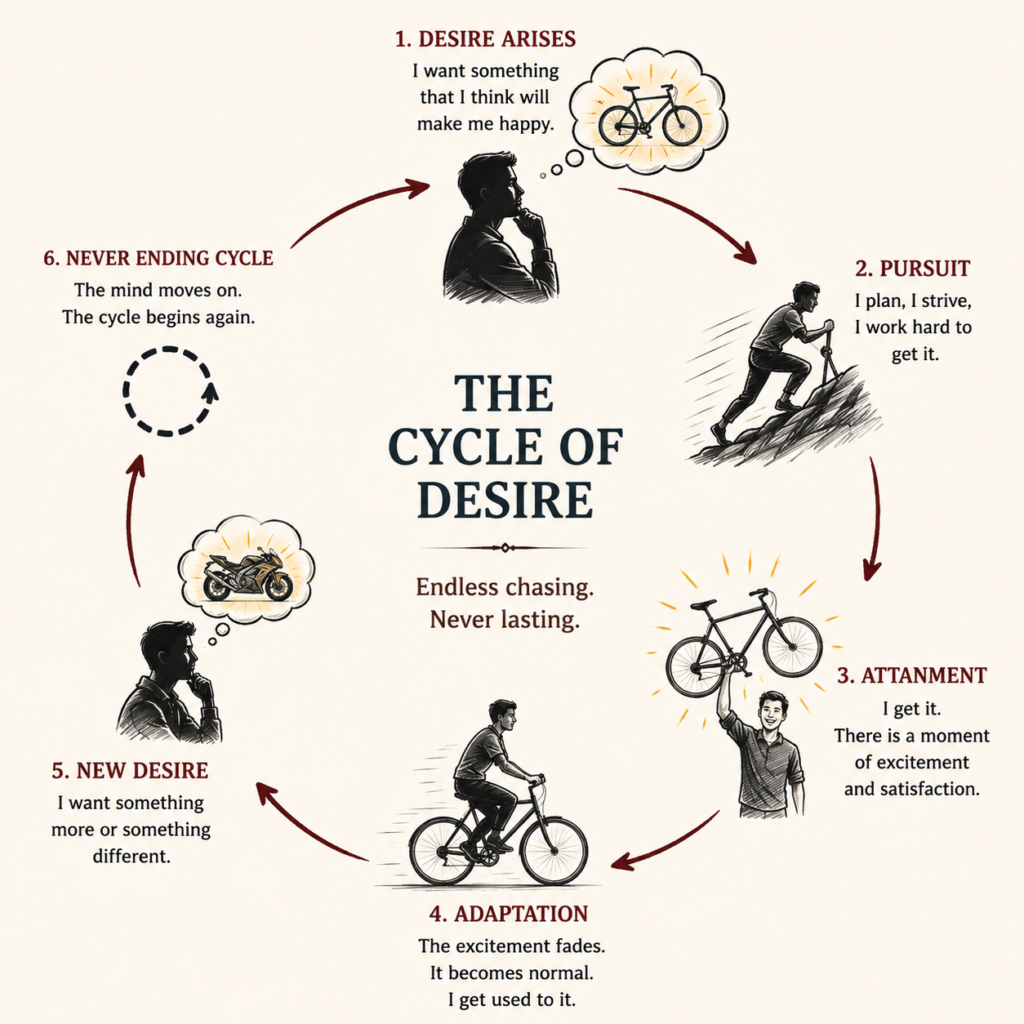
So we strive. We work harder, earn more, acquire more, and achieve more. For a brief period after fulfilling a desire, there is a sense of satisfaction. Then, almost imperceptibly, another desire emerges.
The cycle begins again.
Many people believe that this cycle ends once they become wealthy. It does not.
The poor may desire necessities. The middle class may desire comfort. The wealthy often desire exclusivity, something no one else possesses. And once they possess it, another desire quietly takes its place: the desire to preserve what they already own.
Thus, desire merely changes its form.
The object changes; the mechanism remains the same.
The absence of financial problems does not necessarily produce peace. It often replaces one set of worries with another. Wealth can reduce certain forms of suffering, but it cannot eliminate the restless movement of desire.
As long as the mind continues asking for “something more,” peace remains distant.
What Is Peace?
We often define peace as freedom from conflict or external disturbances. But genuine peace is much more subtle.
Peace is the state in which the mind no longer demands anything.
There is no craving for material possessions.
There is no craving for recognition.
There is not even a craving for spiritual achievement.
The mind simply rests.
This does not mean one stops acting or living. Action can continue. Responsibilities can continue. Success may come or go. The difference is that one’s inner state is no longer dependent on acquiring, protecting, or becoming something.
The silence of desire is peace.
Happiness or Peace?
Perhaps we have misunderstood our own search.
When we say we want happiness, what we actually long for is the quietness that occasionally follows the fulfillment of a desire. We mistakenly attribute that quietness to the object we acquired.
In reality, for a brief moment after obtaining what we wanted, the mind stops wanting. It becomes temporarily free from craving. That temporary absence of desire is experienced as happiness.
Soon another desire appears, disturbing the peace once again.
So the object was never the real source of happiness. It merely interrupted the cycle of desire for a short while.
Our subconscious mind is not searching for pleasure. It is searching for the stillness that exists when there is nothing left to chase.
In other words, what we call the pursuit of happiness is, at its deepest level, the pursuit of peace.
The tragedy is that we often search for peace through the endless multiplication of desires, even though peace begins only when desire itself loses its hold.
Perhaps the destination we have been calling “happiness” has always been peace.
2 Comments